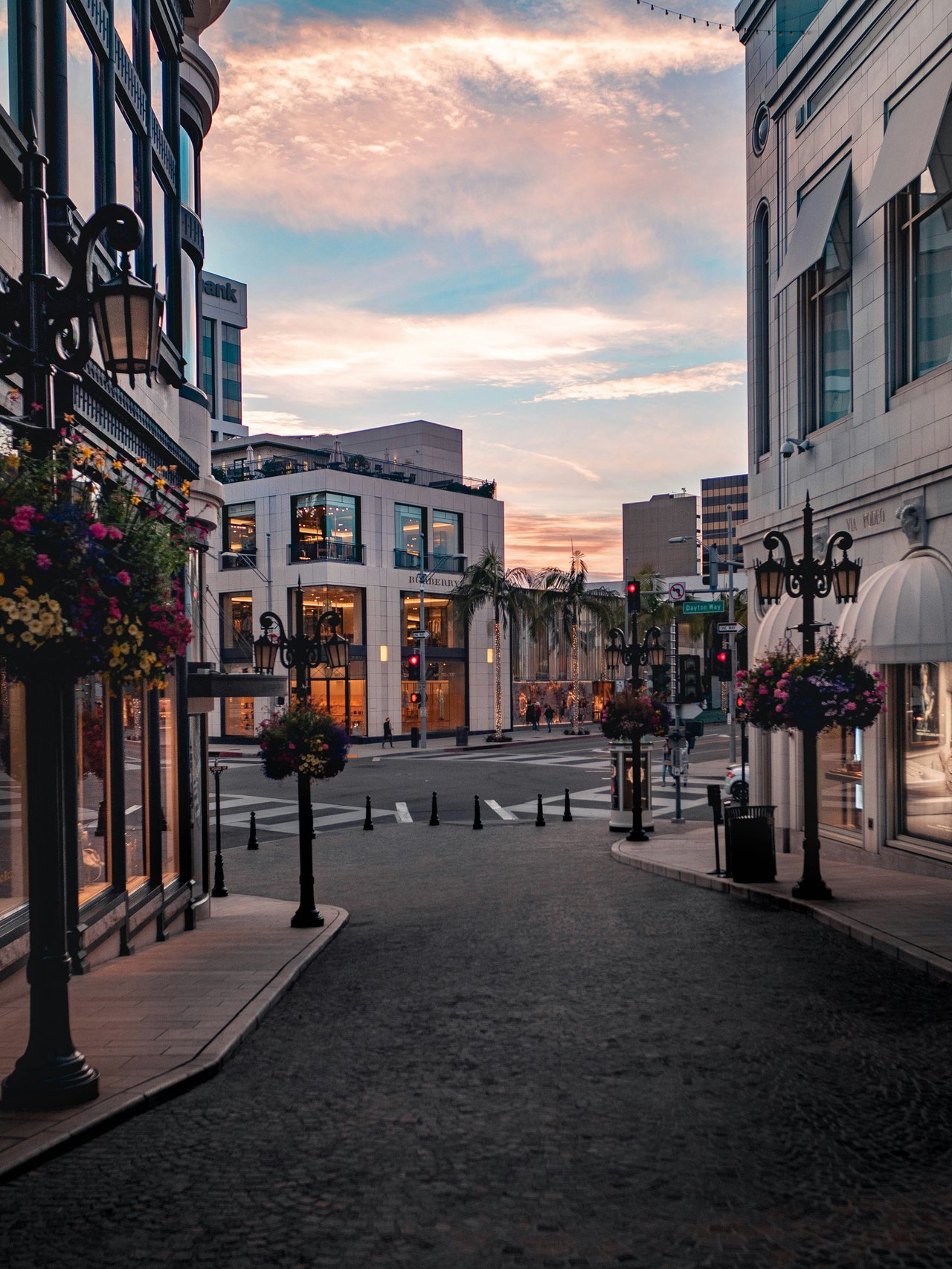
Beverly Hills is the 5.7-square-mile independent city that has defined American luxury for over a century — its own municipality, its own school district, its own police and fire departments, and a residential character that’s been deliberately preserved since the 1920s. The city’s distinct neighborhoods trade at dramatically different price points — from the street-grid "Flats" south of Sunset to the hillside estates of Trousdale Estates and Beverly Park. In 2026, Beverly Hills remains one of the clearest luxury benchmarks in American real estate, and this guide walks through how to think about its distinct districts.
Beverly Hills was originally a ranching community centered around Rancho Rodeo de las Aguas. It was first incorporated as a city in September 1914 by a group of investors who had been drilling for oil and found water instead. Construction of the Beverly Hills Hotel began in 1911 and finished in 1912; visitors drawn by the hotel started buying land; and the population grew fast enough to qualify for incorporation as an independent city by 1914. Urban planner Wilbur David Cook — working in the tradition of Frederick Law Olmsted’s sons — designed the master plan for the city. The wide, tree-lined streets (often up to 70 feet across) and the 50-foot setbacks that define Beverly Hills today came from that original plan. For broader context, see the Beverly Hills Wikipedia entry.
Beverly Hills is small enough that buyers can evaluate the whole city, but distinct enough that the districts function as separate markets:
Beverly Hills’ housing stock is protected by some of the strongest residential preservation policies of any American city — combined with owners who often have the budget to restore rather than replace. The Flats are known for:
Trousdale Estates offers a very different stock — mid-century and later architectural homes designed to capture views, with a concentration of documented modernist pedigree rare in any American neighborhood.
Beverly Hills’ preservation ethos has practical implications for homeowners. Landscape and exterior alterations often require more review than in neighboring LA neighborhoods. Hedge height regulations, setback requirements, and color palette expectations are all meaningful for restoration and remodeling projects. A few practical guides for Beverly Hills homeowners:
Beverly Hills commands some of the highest sustained property values in the country. Typical price bands by district:
Days on market is generally slower than neighboring LA markets — Beverly Hills luxury buyers are unhurried, and well-priced listings are rewarded with buyer patience rather than punished with price cuts.
The Beverly Hills market is relationship-driven. Significant inventory trades privately or off-market; reaching the right buyer for a Flats estate or a Trousdale modernist often depends on networks more than public listing mechanics. For sellers: preparing a home for the specific Beverly Hills buyer profile (international luxury, established professionals, celebrity and creative industry) is where experienced local representation matters. For buyers: understanding the differences between the Flats, Trousdale, BHPO, and Beverly Park — and which district actually fits your life versus which one carries the brand name you’re attracted to — is where local conversation beats portal research.
Common comparisons:
Beverly Hills is the answer when international recognition, municipal services, and the specific combination of districts and luxury retail within one compact city matter most. Hancock Park fits if historic mansions and a quieter central-LA address are the priorities.
Whether you’re buying your first Beverly Hills home, selling a long-held Flats or Trousdale estate, or trying to figure out which district fits your life, I’d love to help you think it through. Browse the current Beverly Hills listings above, or reach out directly for a conversation about the market and your goals.
31,955 people live in Beverly Hills, where the median age is 47.7 and the average individual income is $112,920. Data provided by the U.S. Census Bureau.
Total Population
Median Age
Population Density
Average individual Income
There's plenty to do around Beverly Hills, including shopping, dining, nightlife, parks, and more. Data provided by Walk Score and Yelp.
Explore popular things to do in the area, including Casablanca, Lingerie Theory, and The Swan House.
| Name | Category | Distance | Reviews |
Ratings by
Yelp
|
|---|---|---|---|---|
| Shopping | 0.46 miles | 0 reviews | 0/5 stars | |
| Shopping | 0.57 miles | 0 reviews | 0/5 stars | |
| Shopping | 0.58 miles | 0 reviews | 0/5 stars | |
| Shopping | 0.59 miles | 0 reviews | 0/5 stars | |
| Shopping | 0.59 miles | 0 reviews | 0/5 stars | |
| Shopping | 0.59 miles | 0 reviews | 0/5 stars | |
| Nightlife | 0.54 miles | 0 reviews | 0/5 stars | |
| Beauty | 0.38 miles | 0 reviews | 0/5 stars | |
| Beauty | 0.48 miles | 0 reviews | 0/5 stars | |
| Beauty | 0.48 miles | 15 reviews | 3.7/5 stars | |
| Beauty | 0.49 miles | 1 review | 5/5 stars | |
| Beauty | 0.54 miles | 2 reviews | 3/5 stars | |
| Beauty | 0.58 miles | 0 reviews | 0/5 stars | |
| Beauty | 0.59 miles | 0 reviews | 0/5 stars | |
| Beauty | 0.6 miles | 0 reviews | 0/5 stars | |
| Beauty | 0.61 miles | 1 review | 5/5 stars | |
| Beauty | 0.63 miles | 1 review | 5/5 stars | |
| Beauty | 0.63 miles | 1 review | 5/5 stars | |
| Beauty | 0.63 miles | 1 review | 1/5 stars | |
| Beauty | 0.63 miles | 5 reviews | 5/5 stars | |
| Beauty | 0.63 miles | 0 reviews | 0/5 stars | |
| Beauty | 0.64 miles | 0 reviews | 0/5 stars | |
| Beauty | 0.64 miles | 0 reviews | 0/5 stars | |
| Beauty | 0.64 miles | 0 reviews | 0/5 stars | |
|
|
||||
|
|
||||
|
|
||||
|
|
||||
|
|
||||
|
|
Beverly Hills has 14,263 households, with an average household size of 2.24. Data provided by the U.S. Census Bureau. Here’s what the people living in Beverly Hills do for work — and how long it takes them to get there. Data provided by the U.S. Census Bureau. 31,955 people call Beverly Hills home. The population density is 5,598 and the largest age group is Data provided by the U.S. Census Bureau.
Total Population
Population Density Population Density This is the number of people per square mile in a neighborhood.
Median Age
Men vs Women
Population by Age Group
0-9 Years
10-17 Years
18-24 Years
25-64 Years
65-74 Years
75+ Years
Education Level
Total Households
Average Household Size
Average individual Income
Households with Children
With Children:
Without Children:
Blue vs White Collar Workers
Blue Collar:
White Collar: