
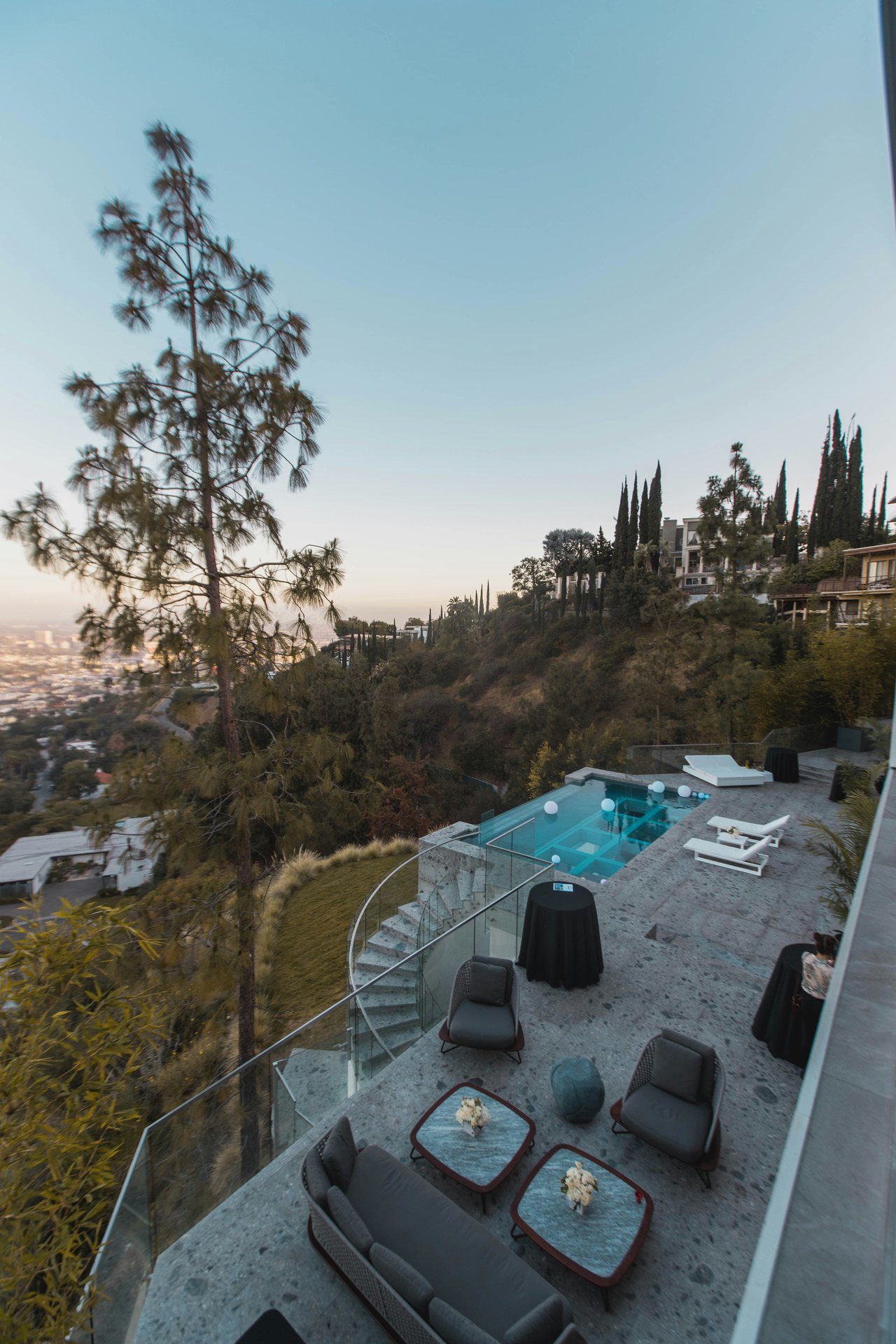
The Hollywood Hills isn’t really a single neighborhood — it’s a collective name for roughly a dozen distinct canyon communities on the southern face of the Santa Monica Mountains, just above central Los Angeles. Residents typically identify with their specific canyon rather than the umbrella term. But for buyers looking from outside, "the Hollywood Hills" is usually the entry point to the conversation. This guide is the map: what the Hollywood Hills actually contains, how the canyons differ, and how to start narrowing down which one fits you.
The Hollywood Hills straddle the Cahuenga Pass within the Santa Monica Mountains, bordered by Studio City, Universal City, and Burbank to the north; Griffith Park to the east; Los Feliz to the southeast; Hollywood to the south; and Hollywood Hills West to the west. US-101 bisects the area southeast-to-northwest. The individual canyon neighborhoods are cut into the mountains as steep, narrow hollows — winding roads, hillside lots, and view premiums that vary by elevation and exposure. For broader context, see the Hollywood Hills Wikipedia entry.
The key sub-neighborhoods that make up the Hollywood Hills, and how they differ:
The Hollywood Hills functions as a living museum of LA architecture. Construction began in the 1920s and has continued in waves ever since:
The Hollywood Hills isn’t a single market — prices vary widely by canyon, by block, and by exposure. Broadly:
The Hollywood Hills overall median is running between $1.85M and $2.4M depending on the pocket, with days on market for well-positioned listings tracking at 18-28 days — materially faster than mid-2024.
The Hollywood Hills lifestyle is privacy, views, and architectural pedigree in exchange for car-centric living, winding roads, and hillside home-maintenance realities. Most Hills residents drive for coffee, groceries, and dinner. Driveways are often steep and narrow; retaining walls are structural; stairways cut into hillsides are a fact of life in older homes. The neighborhoods that locals love most are the ones where the tradeoffs fit their rhythm: Laurel for cultural density, Nichols for architectural quiet, Beachwood for Hollywoodland character, Outpost for practicality.
If you’re new to hillside living, our stress-free moving guide covers logistics worth planning for.
The framework I walk first-time Hollywood Hills buyers through:
Whether you’re buying your first canyon home, selling a long-held Hills property, or just trying to figure out which pocket fits your life, I’d love to help you think it through. Start with the specific canyon guides above — Laurel, Nichols, and Beachwood — or reach out directly for a conversation about where to start looking.
21,476 people live in Hollywood Hills, where the median age is 42 and the average individual income is $102,851. Data provided by the U.S. Census Bureau.
Total Population
Median Age
Population Density
Average individual Income
There's plenty to do around Hollywood Hills, including shopping, dining, nightlife, parks, and more. Data provided by Walk Score and Yelp.
Explore popular things to do in the area, including Restaurants , Delicatesen, The Daily Planet, and Innsdale Trailhead.
| Name | Category | Distance | Reviews |
Ratings by
Yelp
|
|---|---|---|---|---|
| Dining | 1.62 miles | 0 reviews | 0/5 stars | |
| Shopping | 1.6 miles | 54 reviews | 3.7/5 stars | |
| Active | 0.26 miles | 0 reviews | 0/5 stars | |
| Active | 1.45 miles | 0 reviews | 0/5 stars | |
| Beauty | 0.12 miles | 0 reviews | 0/5 stars | |
| Beauty | 0.12 miles | 0 reviews | 0/5 stars | |
| Beauty | 1.5 miles | 2 reviews | 5/5 stars | |
|
|
||||
|
|
||||
|
|
||||
|
|
||||
|
|
||||
|
|
Hollywood Hills has 12,241 households, with an average household size of 2. Data provided by the U.S. Census Bureau. Here’s what the people living in Hollywood Hills do for work — and how long it takes them to get there. Data provided by the U.S. Census Bureau. 21,476 people call Hollywood Hills home. The population density is 9,231 and the largest age group is Data provided by the U.S. Census Bureau.
Total Population
Population Density Population Density This is the number of people per square mile in a neighborhood.
Median Age
Men vs Women
Population by Age Group
0-9 Years
10-17 Years
18-24 Years
25-64 Years
65-74 Years
75+ Years
Education Level
Total Households
Average Household Size
Average individual Income
Households with Children
With Children:
Without Children:
Blue vs White Collar Workers
Blue Collar:
White Collar:
The Hollywood Hills is a collective name for roughly a dozen canyon communities above central Los Angeles. Residents often identify with their specific canyon rather than with the Hollywood Hills as a whole.
Entry-level canyon homes with small lots and partial or no views are generally $1.2 million to $1.8 million, while classic canyon homes are about $1.8 million to $3 million. View homes and architectural properties run about $3 million to $6 million or more, and estate-scale properties start around $6 million.
Most Hollywood Hills residents drive for coffee, groceries, and dinner. Runyon Canyon and Franklin Village sit near the Franklin Avenue commercial strip, but the description does not give a walkability rating for individual streets.
The Hills offer privacy and views, but daily life is car-centric and roads are winding. Driveways can be steep and narrow, and older hillside homes may have retaining walls and stairways cut into the slope.
Nichols Canyon is quieter than Laurel Canyon, which has more cut-through traffic along its boulevard to Studio City. Beachwood Canyon has more tourist foot traffic near its landmarks, while Cahuenga Pass has freeway-adjacent trade-offs.
Outpost Estates is relatively flat by canyon standards and has one of the better parking and access profiles in the Hills. The flatter parts of Hollywood Dell are another place to consider for easier access.
Nichols Canyon has a concentration of mid-century modernist architecture, including work by Richard Neutra, John Lautner, and Pierre Koenig. Outpost Estates also has a strong mid-century housing stock.
Beachwood Canyon includes the original 1923 Hollywoodland development, with Storybook and Spanish architecture. Whitley Heights has historic Mediterranean homes and Historic Preservation Overlay Zone protection; Outpost Estates also has HPOZ protection.
Cahuenga Pass is described as a more affordable entry point, though it comes with freeway-adjacent trade-offs. Hollywood Dell and Hollywood Heights are also more attainable hillside enclaves, and the lower reaches of several canyons can offer entry-level prices.
Prices vary by canyon, block, elevation, and exposure. The stated ranges put entry-level homes with partial or no views at $1.2 million to $1.8 million, compared with $3 million to $6 million or more for view homes and architectural properties.