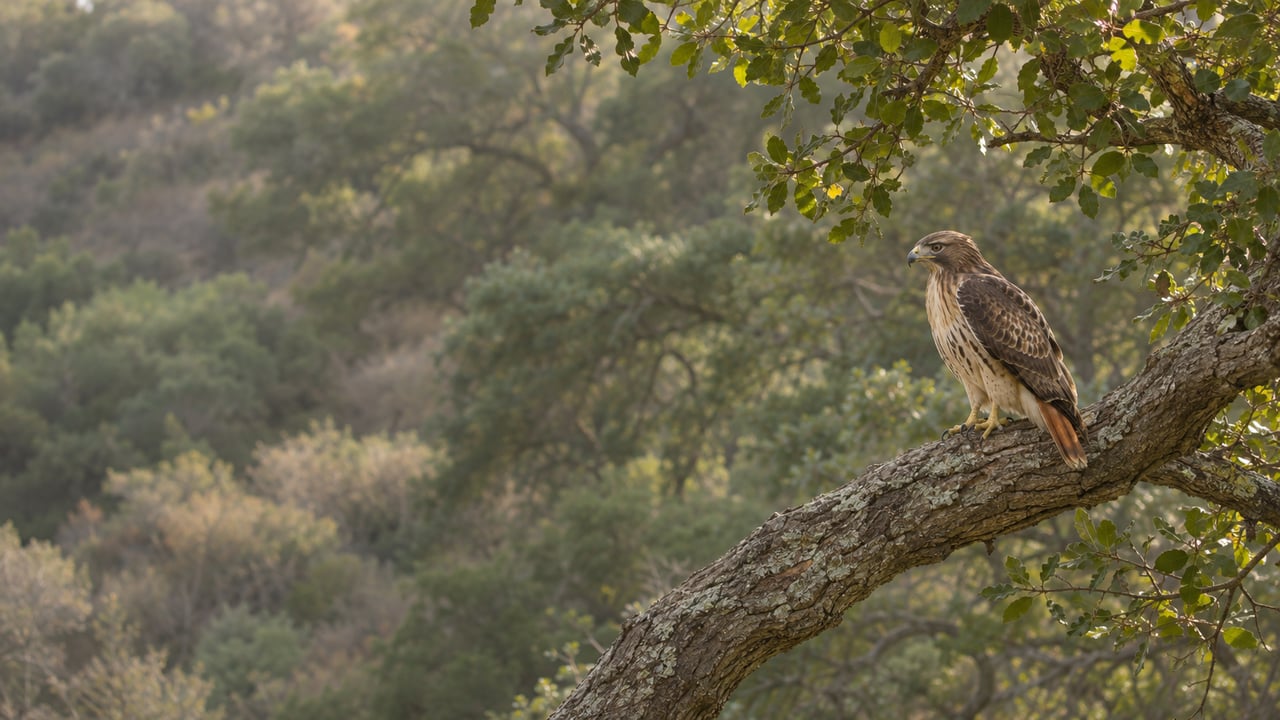
On March 16, 2023, a volunteer with the Los Angeles Raptor Study walked up to the red-tailed hawk nest she had watched in upper Beachwood Canyon for three seasons. The pair had raised three chicks there in 2021 and two in 2022. That morning the nest was gone, destroyed by weather, and for more than a month she saw no sign of the birds.
The pair turned up again through the neighborhood newsletter. Beachwood neighbor Eric Smith sent the Beachwood Canyon Neighborhood Association a hawk photo, and the newsletter ran it on May 1. Gerry Hans, president of Friends of Griffith Park, saw it, asked Smith where he had taken it, and recognized the same pair in a new nest. By early summer two chicks were doing the "jump-flapping" that comes before a first flight. The volunteer told the story in BCNA's July 2023 newsletter.
Most people in the canyon meet these birds in spring, when there are chicks in the nests and the adults are hunting. But the season that ends in those spring sightings starts in November. After the study's least productive year on record, the next few months are the ones that count.
A tenth season, and a thin one
The Friends of Griffith Park 2026 LA Raptor Study final report is dated September 13, 2026. The project began as the Griffith Park Raptor Survey in 2017, became the Los Angeles Raptor Study in 2021, and has now reached its tenth year. By August 2026 its volunteers had mapped nearly 800 potential raptor territories across the study area.
The territory count held up. The number of chicks did not. The four species the study follows most closely produced 420 young in 2026, about 90 fewer than the year before. Active nests averaged 1.86 chicks, the lowest figure the study has recorded, against an average of 2.1 since 2017.
| Species | Active territories, 2026 | Territories that fledged young, 2026 | Young, 2025 | Young, 2026 |
|---|---|---|---|---|
| Red-tailed hawk | 152 | 108 | 198 | 179 |
| Cooper's hawk | 92 | 77 | 207 | 148 |
| Red-shouldered hawk | 39 | 28 | 36 | 46 |
| Great horned owl | 41 | 28 | 73 | 47 |
The red-tails are the hawks most people in Beachwood see circling over the ridgelines. They had about as many active territories as in 2025 but fewer young. Great horned owls fledged young from a similar share of territories as the year before, yet the number of owlets dropped from 73 to 47. Red-shouldered hawks were the one species that improved.
Weather doesn't explain it neatly. Over ten years, the study found that seasons after the driest winters had more red-tail nests with a single chick. The 2025–26 winter was moderately wet, with rainfall 4.27 inches above the historical average, and 2026 still had the highest share of one-chick nests since the study began. The authors conclude that many other factors are involved.
What took down the nests that failed
The report lists 14 failed nests among the four main species. Human disturbance was documented or strongly suspected in three of them. One of the three was close to home. A red-tail nest at Mineral Wells in Griffith Park was abandoned after observers saw a drone flying near it early in the season. In Hancock Park, someone trimmed a tree while an adult Cooper's hawk was incubating, and the report says that nest was illegally removed. Another nest failed after construction netting was placed directly around it.
The broader disturbance log also includes sites near the canyon. In Los Feliz, several red-shouldered hawk nest sites were lost when trees were removed or trimmed, and no nests remained. A Cooper's hawk site in Hollywood was trimmed back against a freeway wall. The total did drop. The study recorded 18 apparent nest disturbances in 2026, compared with 38 in 2025 and 28 in 2024.
The report names areas but not precise nest locations. The authors hold those back to limit disturbance and to protect residents' privacy, so it has no count for Beachwood Canyon itself. It does name the Hollywood Reservoir among the LADWP-managed public lands that support raptor nests. And Griffith Park is one of the two areas where the report finds red-tailed hawks especially numerous. A peregrine falcon nest on a natural rock formation inside the park was also monitored in 2026.
Why November is the start of the season
The owls start first. The study's 2017 Griffith Park report says great horned owls begin nesting earlier than any other local raptor, by day or by night, and often start in fall. They also tend to take over nests other birds have left, including old hawk and raven nests. The same report says red-tailed hawks can start building nests as early as December. Cooper's hawks nest later, so the study runs a separate April training for volunteers who monitor them.
Fall and winter are also when hillside trees get trimmed. The 2026 report says trimming in fall and winter, outside the nesting season, doesn't always seriously disturb nesting hawks, even when nest structures come down. Many pairs nest again in the same territory, either in what is left of the old nest or in a new one nearby. Red-tails are the exception. Since 2017 the study has seen them abandon territories after tree or nest removal more often than other species, and several pairs still haven't returned even though plenty of suitable trees remain.
Empty nests still matter to the study. The report shows a red-tail nest in Sherman Oaks that was trimmed out after its chicks had fledged. The authors note that removing it was still against state law because raptors reuse their nests from year to year, and that pair had not come back as of 2026. The law in question is California Fish and Game Code section 3503.5. It makes it unlawful to take, possess or destroy birds of prey or their nests or eggs, with the exceptions written into statute and regulation. For residents and contractors, the study offers tree signs and mailbox letters explaining nest protections.
What's in a bait box ends up in an owl
The Beachwood volunteer whose nest blew down joined the study because of an owl. In May 2020, while walking her dogs, she found a great horned owl sitting on the ground on a sunny morning, and it died a few minutes later. Gerry Hans had the bird tested. UC Davis CAHFS found the cause of death was anticoagulant intoxication, with a very high level of the second-generation rodenticide difethialone. She wrote that the owl had most likely caught a slow-moving rodent that had eaten from a bait box.
The 2026 report shows how common that is. Every dead raptor tested in the study area has had multiple rodenticides in its system, and in some birds the poison was the likely cause of death. In May 2026, study leaders worked with LA Recreation and Parks and Bloom Research to band the first hawk nestlings in Griffith Park. Luis Diaz of Rec and Parks Urban Forestry got the team up three tall nest trees, and graduate students drew blood from the nestlings for research co-led by Cal Poly Pomona's Dr. Andrea Bonisoli Alquati and raptor biologist Dr. Pete Bloom. The research looks at how anticoagulant rodenticides affect red-tailed and red-shouldered hawks. The color bands on those birds will make them easier to spot and report when they return to nest in the park or nearby.
State law has tightened in the years since that owl died:
- AB 1788, signed in 2020, banned second-generation anticoagulant rodenticides statewide, with specified exemptions. The ban stays in place until the Department of Pesticide Regulation completes a required reevaluation and meets certain certification conditions.
- AB 2552, signed in 2024, extended restrictions to first-generation compounds in wildlife habitat areas and generally banned chlorophacinone and warfarin statewide, with exemptions. According to the Department of Pesticide Regulation, those restrictions took effect January 1, 2025, and most residential uses of both first- and second-generation anticoagulants are now prohibited.
- DPR's enforcement reference dated January 28, 2026 still lists these prohibitions. DPR also held a public workshop in September 2025 on further proposed mitigation for both classes of rodenticide.
This post is general information, not legal advice. If you're planning tree work or pest control, check the current rules with your arborist, your pest-control provider or DPR.
Joining the 2027 count
The upper Beachwood nest was tracked by a neighbor who volunteered, and the study still runs on volunteers. In 2026, training began with a Zoom session on January 28, followed by field trainings in Griffith Park on January 31 and in the Sepulveda Basin on February 1. Volunteers are assigned nests based on where they live and how experienced they are with birds. They visit about twice a month, no more than once a week, and enter their observations within a week.
The Friends of Griffith Park raptor study page has the application, and questions go to [email protected]. Its general schedule looks like this:
- Late January to early February: training and nest searching
- March: nest assignments
- April to June: monitoring
- July to August: analysis and results
If you live in the canyon and want to help, now is the time to apply, since the owls are already starting.
The fall newsletters and the spring nest photos are part of what makes Beachwood Canyon feel like home, for us as much as for anyone. If you're watching a hawk pair from your deck this winter and want to talk about the canyon, its trees or your own plans here, Carolina Kramer would be glad to hear from you.