
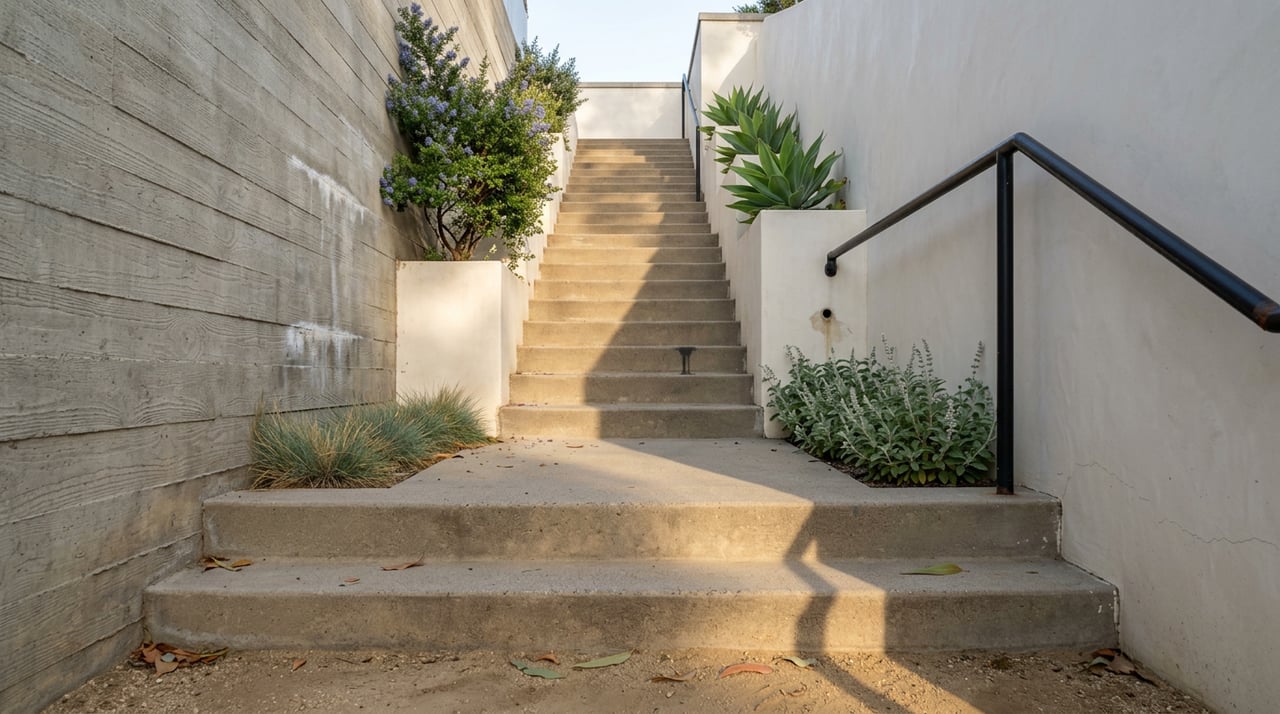
One morning in April 2022, a Silver Lake resident out for an early walk noticed something wrong at the Micheltorena Stairs. The heart-covered steps that had drawn photographers from around the world for seven years were gone, painted over in flat white paint overnight. Nobody knew who did it. The city denied responsibility. Within weeks, one of the original artists had flown in from Melbourne, Australia, to lead a volunteer crew back up the same 177 steps and repaint the whole thing by hand.
That reaction tells you more about Silver Lake than any listicle of its murals ever could. These are municipal concrete steps. They connect a residential street to another residential street. And when someone defaced them, the neighborhood organized a rescue mission for public infrastructure that serves no practical function beyond letting you climb a hill slightly more scenically than the sidewalk would. The stairs aren't relics that Silver Lake tolerates. They're something the neighborhood actively fights to keep.
A Neighborhood Built to Walk Uphill
The reason these stairs exist at all has nothing to do with fitness or Instagram. Most of Silver Lake's public stairways were poured in the 1920s to give pedestrians a direct route between hillside homes and the Pacific Electric Railway's Red Car lines running below. The longest of them, the 182-step Loma Vista Stairs, connected straight to PE's Glendale-Burbank Line. On the Elysian Heights side, the Cove Avenue Stairs led down to what was then the Edendale and Semi-Tropic Park station, serving a neighborhood that predates Silver Lake's name and was once the hub of West Coast filmmaking, home to more than thirty early studios along what's now Glendale Boulevard.
That transit service ended in 1955. The right-of-way was absorbed into the Glendale Freeway stub a few years later, and Edendale faded from the map entirely, split between what we now call Silver Lake and Echo Park. The commuters these stairs were built for have been gone for seven decades. The stairs themselves never left.
The Streetcars Are Gone. The Stairs Never Got the Memo.
What happened instead is that a piece of infrastructure built for one purpose got adopted for an entirely different one, and the neighborhood decided that was worth defending. The Descanso-Vendome Stairs, at 133 steps connecting Vendome Street to Descanso Drive, would have stayed an anonymous shortcut if Laurel and Hardy hadn't filmed their Oscar-winning short The Music Box there in 1932, hauling a player piano up the same steps that once carried commuters down to the trolley. Stan Laurel had already used a different set, the Cove Avenue Stairs, a decade earlier in a 1922 short called The Pest. In 2024, the Los Angeles City Council formally named the intersection at the base of the Music Box Steps in honor of the film, and the block still draws visitors who've never set foot in Los Angeles otherwise.
A few blocks over, the Micheltorena Stairs became something different: a canvas. Artist Corinne Carrey and collaborators Carla O'Brien and Mandon Bossi painted the steps as a rainbow of hearts in 2015, working at night without permission. The city didn't touch it. In fact, the Cultural Affairs Commission retroactively approved the piece, known as Stair Candy, as an official public art project in 2019, four years after it was already a fixture of the neighborhood. That's the sequence that matters here: the community adopted the art first, and the bureaucracy caught up to what residents had already decided was theirs to keep.
The Swan Stairs tell a quieter version of the same story. Artist Evelyn Leigh has been adding color to the three descending flights there since 2015, including a mural titled Je T'aime LA at the top set on Rotary Drive. The Murray Stairs, sometimes called the Piano Stairs, got their own Carrey treatment, painted to resemble piano keys in a piece the Cultural Affairs Commission records list as Stair Tempo. And the Mattachine Steps, near the reservoir, carry a different kind of weight entirely. They were renamed to honor the Mattachine Society, one of the first LGBTQ+ rights organizations in the country, founded in Silver Lake in the 1950s. No mural marks that history. The name does the work instead.
"Our original artistic vision has been overwhelming," artist Carla O'Brien said after the 2022 restoration, crediting the Silver Lake Improvement Association and neighbors for the support.
None of these staircases required a mural or a film credit to keep functioning as stairs. Every one of them got one anyway, because residents kept deciding that the walk deserved more than plain concrete.
Thirty Years of Keeping the Steps Alive
The organization behind a lot of this isn't the city. It's the Silver Lake Improvement Association, a volunteer group formed in 1989 by neighbors who set out to address crime, graffiti, and neglected corners of the neighborhood using little more than persistence and a small graffiti-abatement grant from their council district. SLIA is also the group that funded the Micheltorena restoration crew and has sponsored Music Box Steps Day at Laurel and Hardy Park for more than three decades running, a free October festival built entirely around a staircase that leads to a residential street and nothing else. The event has drawn a great-granddaughter of Stan Laurel as a guest, screenings of the restored 1932 short, and, in recent years, official city recognition of the site's history.
That's a genuinely unusual thing for a neighborhood to sustain for thirty-plus years. Most public infrastructure gets maintained because it has to be. Silver Lake's stairs get maintained, muraled, and festival-ed because residents keep choosing to make them mean something.
How Locals Actually Build a Loop
If you want to walk this network the way people who live here actually do, rather than treating it as a single-stop photo errand, the stairs link into a route that rewards a slower pace:
- Start at the Music Box Steps on Vendome Street, across from Laurel and Hardy Park, and read the small plaque at the base before you climb.
- Head north on Descanso Drive to the Descanso Stairs, then cut over to Micheltorena Street to reach the heart-painted Micheltorena Stairs, the piece that survived its own vandalism in 2022.
- Cross Sunset and pick up the Murray Stairs, painted as piano keys, before working toward the Swan Stairs off Webster Avenue for the steepest climb on the route.
- If you have another mile in you, the Mattachine Steps near the reservoir add a quieter, shadier detour with a view back over the water.
Street parking is generally easiest near Sunset and Micheltorena, though posted signs and street-cleaning days are worth a glance before you leave the car. Alfred's Coffee sits right at the base of the Micheltorena Stairs if you want a reason to start there, and Muddy Paw a few doors down is the dog-friendlier option if you're bringing a leash along for the climb. Pine & Crane, a short walk up Sunset, is the standard reward at the end for anyone who's just climbed four separate staircases before lunch.
The Point of Stairs That Lead Nowhere
What makes this network worth understanding, rather than just walking, is what it says about how this particular neighborhood treats the things it inherited. The Pacific Electric Railway is gone. The commuters these steps were poured for have been gone since Eisenhower was president. And yet nobody tore the stairs out, nobody let them crumble, and when someone did try to erase one of them, the response was immediate and organized. Silver Lake didn't preserve these stairs because a historic registry required it. Residents preserved them because they'd already decided the stairs were part of how the neighborhood works, long after the original reason for building them disappeared.
That's a useful thing to notice if you're spending time in this neighborhood, whether you've lived here for twenty years or you're still getting your bearings. The stair streets are a small, specific example of a larger pattern: this is a place that keeps its infrastructure even after its original purpose expires, and turns it into something worth defending instead.
If you're curious about what else in Silver Lake carries that same kind of layered history, or you're thinking about your own place in this neighborhood's next chapter, Carolina Kramer knows these streets, stairs included, better than most.