
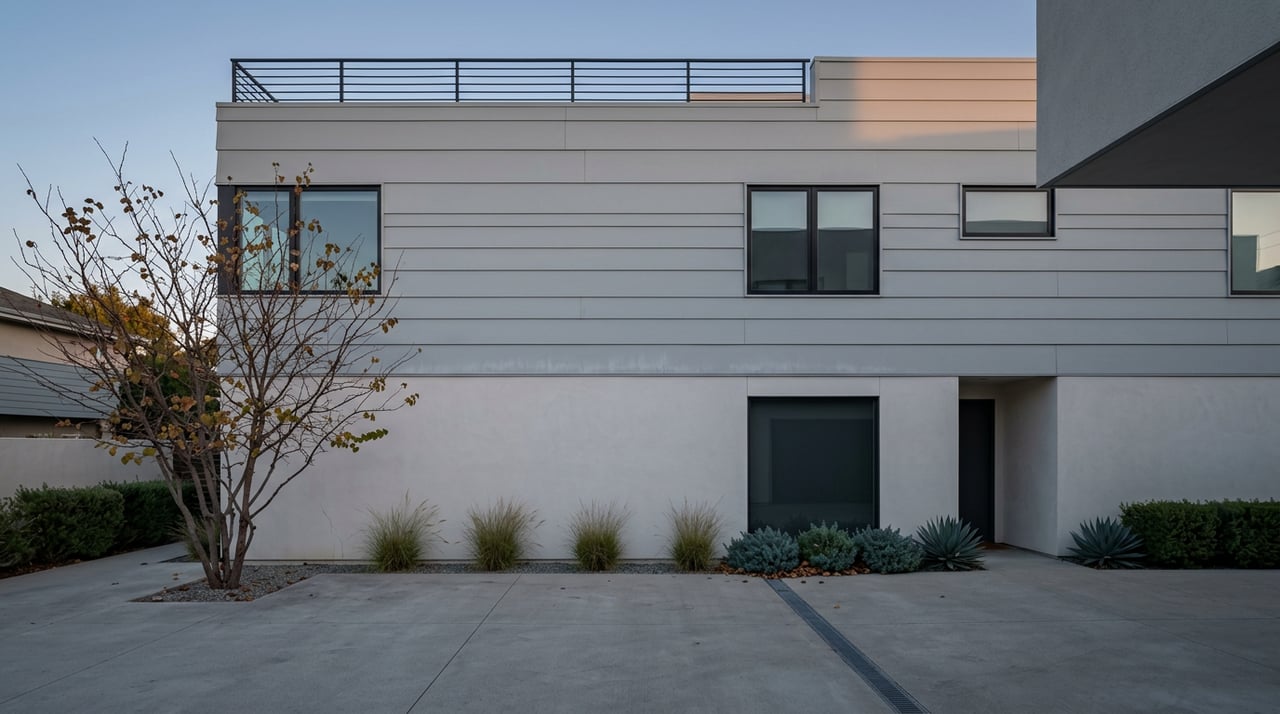
Walk two open houses on the same Saturday in Silver Lake and you'll notice something odd. One is a three-bedroom built in 1926, sitting on a normal-sized lot with a side yard and a detached garage. The other, four blocks away, is a three-story new build from the last decade, tucked behind a shared driveway with no yard at all, priced almost identically per square foot. Both listings say "Silver Lake." Both show up in the same comp pull. And if you've already started pricing this neighborhood on the major portals, you've probably noticed the median numbers themselves don't agree either.
That's not a data error. It's two separate things happening at once, and once you see them, you'll read every Silver Lake listing differently.
The Same Neighborhood, Three Different Numbers
As of March 2026, Redfin had Silver Lake's median sale price at $1.4 million, down 17.5 percent year over year, with a median price per square foot of $868. A few months later, Movoto's June 2026 figures showed a median list price of $1.53 million and $840 per square foot, with days on market falling 12 percent from the year before. Zillow's home value index, updated through April 2026, told a third story entirely: an average home value of $1,463,439, essentially flat, up just 0.1 percent over the year.
One source says the market dropped nearly a fifth. Another says it's basically holding steady. A third is quoting list price rather than sold price. These aren't small rounding differences you can wave off. They're measuring different things, and the reasons why matter more to a buyer than any single number on the page.
Half a Mile of Rowena Avenue Explains Part of It
Start with what's actually getting built. Los Angeles's Small Lot Subdivision Ordinance, in place since 2005, lets a developer subdivide a single urban parcel into several fee-simple lots, each with its own detached house. Buyers get the ownership structure of a house, land included, typically with no HOA or a very light one, at a price point closer to a townhome. Silver Lake has become one of the format's busiest testing grounds, and the Rowena Avenue corridor shows the pattern clearly.
Back in 2020, Los Angeles planning officials approved a six-home small-lot project at 2820 W. Rowena Avenue, replacing two 1930s buildings a half mile east of the Rowena Reservoir. Architect Tracy A. Stone designed the row: three stories each, stucco and horizontal siding, a two-car garage and rooftop deck per unit. The land itself had sold for $2.35 million in 2018, before a single unit broke ground.
That project wasn't a one-off. As of early 2026, five more small-lot homes were rising at 2772 Rowena Ave, just down the same street. A few blocks over on Hyperion, four small-lot houses were pitched for 1132 N. Hyperion Ave in late 2025, with a similar project proposed a short walk south across Sunset at 1046 Hyperion Ave. This is a sustained pattern along two of Silver Lake's main corridors, not a single building somebody happened to notice.
Here's why that matters for a comp: a small-lot home and a 1920s bungalow are not the same product wearing different paint. They're structurally different investments, and treating them as interchangeable on price alone is where buyers get burned.
| Pre-1940 bungalow or Spanish Revival | Small-lot new construction | |
|---|---|---|
| Ownership | Fee simple, standard lot | Fee simple, subdivided micro-lot |
| HOA | Rare | Typically none or minimal |
| Outdoor space | Yard, often a driveway of its own | Often none, shared driveway/entry |
| Typical footprint | Single or two story | Three story, rooftop deck common |
| Year built | 1900s to 1940s | Predominantly 2010s to present |
A three-story small-lot house with no yard and a shared driveway easement is not a comp for the craftsman next door just because both closed at a similar price per square foot last quarter.
The difference isn't better or worse. It's a different set of tradeoffs: more square footage per dollar and lower maintenance against less privacy and no outdoor land of your own. But when both product types get folded into a single "Silver Lake single-family" median, that median stops describing anything a buyer can actually use to price an individual listing.
The Boundary Problem Sits Underneath the Product Problem
Even if every home in Silver Lake were the same product, the portals still wouldn't agree, because they aren't drawing the neighborhood the same way. Local multiple listing data groups Silver Lake and Echo Park sales together under one shared area code, without a separate designation for either neighborhood on its own. Zillow, Redfin, and Movoto each draw their own polygon around what they call "Silver Lake" for reporting purposes, and none of those polygons has to match the MLS grouping, or each other.
So when three platforms publish three different medians for the same month, part of the gap is genuinely different underlying sales data. A sold-price median calculated off a boundary that includes some Echo Park transactions is answering a different question than an index built from Zillow's own neighborhood shape. Add in the small-lot mix from the section above, and you have two independent reasons the "Silver Lake median" moves around depending on who's quoting it and where their line gets drawn that month.
How to Actually Compare Two Silver Lake Listings
None of this means the data is useless. It means a single headline number needs a few follow-up questions before you can trust it for your specific decision.
- Check the year built before you check the price per square foot. A 2016 small-lot home and a 1928 Spanish Revival are answering different questions even at an identical dollar figure.
- Ask what the ownership structure actually includes. Does the "detached" home come with its own driveway and side yard, or a shared easement and no land beyond the footprint of the house?
- Find out which boundary produced the "median" you're looking at. A number pulled from a source that folds in Echo Park sales is not describing the same market as a hand-pulled set of comps limited to streets you'd actually consider.
- Separate your comp set into like-for-like buckets. Compare pre-1940 stock to pre-1940 stock, and small-lot new construction to other small-lot new construction, before you draw any conclusion about what a specific listing should cost.
- Watch the corridors where the small-lot pipeline is active. Rowena Avenue and Hyperion Avenue have each seen multiple small-lot projects land within blocks of one another over the past several years, which means the mix of what's for sale on those specific streets is shifting faster than the neighborhood-wide median can reflect.
Frequently Asked Questions
Does a small-lot home appraise the same way as a traditional single-family house? Both are fee-simple detached properties, so they're treated as single-family for financing purposes. But an appraiser pulling comps still needs to account for the differences in lot size, outdoor space, and construction era, which is exactly why mixing the two product types into one blended price-per-square-foot figure can distort what either type is actually worth.
Is Silver Lake's market cooling or holding steady? Depends which figure you're reading and why. A sold-price median can fall while an index of estimated values stays flat, particularly when the two are drawing from different boundaries and a different mix of home types month to month. The honest answer requires looking at your specific comp set, not the neighborhood-wide headline.
Are more small-lot projects coming to Silver Lake? The pattern along Rowena and Hyperion suggests the format isn't slowing down. Anyone comparing homes on those corridors should expect the mix of available inventory to keep shifting between vintage stock and new small-lot construction.
Working Through the Numbers With Someone Who Reads Them for a Living
A median price is a starting point, not an answer. If you're comparing homes in Silver Lake right now, the number that matters is the one built from a comp set that actually matches what you're buying: same era, same product type, same few blocks. Carolina Kramer works this market street by street, corridor by corridor, and can walk you through which comps actually apply to the listing in front of you. Explore properties currently on the market and get a comparison that accounts for what's really changed on your block.